Sunday, May 15, 2011

2011 UPDATE: Using Lightroom Across a Network!!!


About a year and a half ago I posted this blog entry about a back door trick I found online that allows you to access Adobe Lightroom catalog files across a Network. This includes accessing them on a NAS (Network Attached Storage) or on another system on you network.

Well, I am here to tell you that we have had NO problems with it even after upgrading to version 3 and IT WORKS AWESOME!!

So before you read on, keep in mind that the instruction you are about to see here below amount to nothing more than writing a one or two line text file in Microsoft Notepad and including a shortcut to it in your start-up folder. We just broke it down as much as we could so it would be easy to follow.

So when we first started using this, I had some apprehensions as I was really worried about the potential for damaging a Catalog file when, inevitably, we would mistakenly try to simultaneously access a catalog file. When I first wrote this blog entry, I deemed this "CROSSING THE STREAMS"


Well, it did in fact happen to us and the only ill affect was that it did not open for the second user. Gail had a catalog file open on her system that I was also trying to access from mine. After waiting several minutes and not seeing it open on my system, I realized what was happening. So it looks as though Adobe already had some means of locking multiple users out of trying to access the same cat file.


So, why did we want this?
The problem Gail and I had was that in our small home Network, we always had an issue with me keeping the Lightroom catalog files local to my system. Granted I do 95% of the initial editing so it made sense, but the problem always came up when she needed to re-export files or modify images for the customer but, she did not have access to it. Previously this meant she had to interrupt what I doing and/or kick me off of my work station.

This is the plight of many Lightroom users and I think everyone would agree this is the last big step Adobe needs to take with LR.


One thing to note...
Anything you do to your system is YOUR responsibility. This is why I handed to our experienced tech.


That said, all the instructions you see here below amount to nothing more than writing a one or two line batch file and including a shortcut to it in your start-up folder. Our tech considers it pretty much harmless.


STEP 1

On the PC hosting the cat file...
If you plan to access a catalog file on another computer or a hard drive connected to another computer, it must be first shared under the properties tabs and also check "Allow users to change my files" otherwise Lightroom will fail to open from the remote system.


STEP 2


Go to the computer that you will be remotely accessing the LR catalog file from and obtain the actual network address for where the catalog files are located. Do this by opening the "My Network Places" window from the remote workstation and be sure to right click and use the "View Details" view. Looking at the below graphic, you can see that in our case "\\d63rgzc1\current lr work" is my system address followed by the specific folder I will be sharing with her over the network and “\\drobo-fs\asa-network” is our Drobo-FS (NAS system). We will be "mounting" both of these network locations as local to Gail's works station as far as Lightroom is concerned.


STEP 3


In Notepad, open a new file and save it as "Start.bat".

Using those addresses you located in the above step, create a command line in the "Start.bat" file for each of the drive(s)/network locations you would like to access that has your catalog files (might be only one in your case).


The “subst L:” command tells the computer to substitute/create a drive named “L” as a local address letter on that PC which points to "//d63grzc1/current LR work" which is the folder on my system where I keep the catalog file that Gail needs to access.

The "subst S:" command does the same thing but to a Drobo network attached storage unit on our office network.

Once you are done with that, save the “Start.bat” file in the “All Users” folder of that workstation (see below).


STEP 4
Then you want to create a shortcut of this file (right click, create shortcut) as seen below.


Font size


STEP 5
Rename this shortcut to something you might recognize or mistake for a virus as we did. In this case (below) we renamed the shortcut “Map Drobo Drive” just so we know not to scrub by accident thinking it was malicious. You can name it anything you want.


STEP 6

Drag and drop this shortcut into your Startup folder. “C:\Documents and Settings\All Users\Start Menu\Programs\Startup” folder (as seen below). This will now run upon system start-up.


After which that drive(s) might start showing up as they did for us as "Disconnected Network Drive" (below). That is just the way they are going to show up, disregard it. Renaming it won't work as each time you reboot the computer it will most likely reset.


FINISHED!!

NOW REMEMBER! From this point on, whenever you are trying to access a catalog file remotely make SURE that you are pointing to the correct drive. Notice (below)how these drives now show up under “My Computer" and NOT “My Network Places”. This is important. If you try to access the same catalog file through "My Network Places", Lightroom will not allow it.

Saturday, May 14, 2011

Lightroom and Photoshop: The Peanut Butter and Jelly of your digital workflow!


"Do you use Lightroom or Photoshop?"

I still hear this question all the time and it drives me crazy!!


The question was never there in my opinion.

How did it come to be that people felt they had to choose one or the other? These two powerful tools were meant to be used together in harmony. Sweet and Salty, Ying and Yang and ...oh yes...Peanut Butter and Jelly

I think this all started back when the awesome editing power of LR first came into light. People thought that PS was being challenged for it’s roll as the big Kahuna. Maybe because of this people felt like they had to choose sides, either Photoshop or Lightroom. I think somehow the purpose of these programs has been blurred. Not sure who’s fault it was…it just happened. Never the less, it is there and I see it and hear it all too often. The mindset must change in my opinion or else everyone will be missing the boat!

So lets stop putting these two into the same old “Nikon/Canon”, “PC/Mac” aurguments.

Is LR and awesome editing tool? Yes, absolutely. Does it replace PS. Without a doubt, NO. Now this is not to say that LR doesn’t have powerful editing capabilities and that it hasn’t greatly reduced my time spent in PS, because it does and it has. My ability to locally and globally edit and adjust LARGE amounts of images has skyrocketed while my time spent doing so has decreased dramatically. What LR brought to the table in addition to this is the ability to infinetly group, create multiple variations of, web publish, print, search and keyword images like never before. All this while keeping them organized! Spending less time in PS does not mean that it’s necessity has diminished. The beauty of this relationship is that when I do need to call in the power of PS, LR is the perfect launching point to go there and back again seamlessly. As soon as you save your file in PS, you jump back into LR and there it is: accessible, catalogued and even further editable within LR. What else can you ask for!?

Photoshop is, has been, and will continue to be (as far as I can see anyway) the go to program for major image modifications and element swap out. Not to mention all of the capabilities it gives to graphic artists and animators.

So lets look at some of the major issues people from both camps that I think are holding them back.


From Camp Photoshop:
A lot of people born into PS have a hard time getting there head around importing images into the LR catalogue. From a Photoshop users standpoint one has to think of it as the same task of copying your image files onto the computer itself. You can’t edit your files in PS without putting them on your computer, right? Importing into the catalogue in fact replaces the step of copying the files onto your system. Some people don't realize that importing into Lightroom and copying the images onto your system is done in one step at the exact the same time. As far as not “seeing” your files once you have start to edit them within LR…you just have to start thinking of the LR as you Explorer window or Bridge.

From Camp Lightroom:
Photoshop has been, is and will continue to be the most intricate program for image editing in the world. You have to know that and accept that as soon as you step in the door. So here is my analogy for you if intend to tackle PS. If your wife sends you to the grocery store with a growling stomache and $500 bucks in your pocket…the options are endless. However, if she sends you there with the list "milk and eggs" and gives you $5, your in, your out, end of story. The point to my analogy here is to know what types of things you need to do in PS, learn it, and use it. Get in and Get out. Going in to a program like PS without an understanding of what you need to do is a death trap. Go online and watch a few tutorials or get a book. It is so easy to find online tutorials these days…use them!

So in closing, the decision to use Photoshop or Lightroom is NOT a decision at all. I could not imagine having one without the other…Peanut Butter and Jelly!


Sunday, November 21, 2010

Hyperdrive in-field update: Down but NOT out!


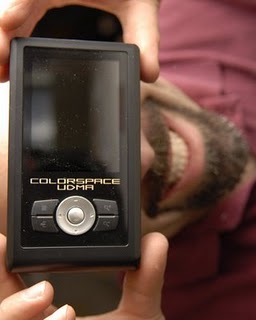
So after being mis-handled and roughed up on many an occasion, we managed to kill (temporarily) the HyperDrive the other day when one of us (not saying any names, but it wasn’t me) decided to move our laptop at the theater the other night because I didn’t “properly distributed the table cloth from front to back”. Well, long story short she ran out of USB cable before the Laptop got to it’s new temporary destination and pulled the Hyperdrive right off the table. When I came back from the rest room she looked at me with “that face”. You all know that face right? I have had “that face” on a couple of times in my career unfortunately.

At first it did not turn on, but I was quickly able to deduce that it sounded as if the battery had come loose. Two screws got the back cover off and I could quickly see that the battery prongs actually were spread due to the impact leaving the battery floating free unable to touch both contacts at the same time. This was an easy in field fix to just bend them back inward. It still turned on and the OS seemed intact, but there was not reading the internal hard drive. This was really not big surprise to me however. That was a 32” fall onto solid a marble floor. Might have faired better if it was in it’s neoprene case, but it wasn’t unfortunately.

I was no doubt depressed as I felt my little friend had just kicked it.

The next morning after checking the support site to confirm the symptoms of the hard drive failure, I ran out to Office Max and picked up a new 2.5” 500Gb hard drive for $80 and I was back online again, but now with DOUBLE the capacity! Nice upgrade! It was an easy plug and play. Two screws to get the back case open, the old drive pulled right out and the new one popped right in. Upon start-up I was prompted to format the new drive, I confirmed, and the Hyperdrive did the rest.

So the conclusion here is that despite a lot of bumping and dumping, this unit has established itself as an ESENTIAL part of our workflow.

If you had read my original review on this, we use this as an intermediate step between our computers and our cameras. Why you might ask? Well here are three BIG reasons that I can not imagine not having this device in our workflow.

- First, for one or more shooters photographing on multiple cards at an event, this serves as an instant on location back-up of your files. We also make sure our clients know that we do this. Mind you we do not erase the cards as they are back, we are simply backing them up.
- Second, when you arrive home from a venue, in a lot of cases late at night, you now have a single source upload to you workstation. This means you can start your upload and go to bed…that's right, nighty night! No waiting around shuffling cards.
- Third, we now have another back-up of all our files dating back anywhere from 4 months to a year depending on our throughput. As the drive fills, I simply dump the oldest 50-100Gb at a time. Now with the new drive, I have easily 400Gbs of history in addition to our back-up systems already in place. This drive has saved our ass on a couple of occasions now.
Another thing to note is that the battery has outlasted my expectations. I have only needed to charge it via the supplied wall plug once or twice as it charges itself via the USB cord whenever it is plugged connected to my PC.

Why not an Espon Storage device you ask? Sure, it will provide the same function, but unless you want to pay almost double for the same amount of space and some extra features (that we have no need for) I would stick with the Hyperspace. (Why buy an expensive multitool when all you need is a screwdriver?)

Check it out…

Friday, May 21, 2010

RS DR-1 Double Strap

Double, NO TROUBLE !!

OK, so this is not me obviously, but this girl is far cuter looking in it than I am.
(This image is from the Black Rapid Website)

Talk about speeding up my shooting!

Felt a little anxious to sport this new gear at first. Then I thought to myself "is it really going to matter George!?" Like I would not look like a photo geek anyway with three cameras hanging off my neck using traditional neck strangling straps!! There really ain't no hiding that I am a photo geek, especially when I am working!

But seriously, talk about speeding up my camera transition time. Shooting theater, this has been one of the biggest improvements to my workflow in a while. Dare I even say that has improved my work.

I pick-up one body and just drop the other, then switch back again and the camera stays right were I left it always oriented, it seems, so my hands land right on the grip. No looking required.

They also have some cool accessory pouches that attach to the upper part. You can check them out in the video at the bottom.

Before that, check out this video Gail snagged of me putting the strap to work on a theater job. Watch how fast my camera transition time is and I am not even trying! Further, I don't even have to look at how the camera is oriented my eyes never leave the show. It is just grab and go!


As for the other dual straps out there (and there are a couple), I have not tried them so I can not pass ANY judgment. I would imagine that these would work similarly, but I will say that I can't imagine having the cameras hanging any other way would do anything but slow down my grip time. That is just me though and it could be just a matter of personal preference.


This is You Tube video from Black Rapid that shows off the strap systems pretty well...

Saturday, March 20, 2010

Dan Doke at ASA Photographic Studios

We are excited about this training "Dynamic Lighting for Weddings and Portraits"--Dan's work is outstanding and we are looking forward to training with him. We will be meeting with Dan early this week to firm up details and will get word out by Wednesday. But, for now, the date is April 25, 9am-4pm.

I am posting this info here because we just learned our server had a "problem" last night and is still being "repaired." UGH! So, if you have landed here after not being able to access our site, rest assured, we'll be back on line...shortly...isn't that what they always say?

LOL
Gail

Thursday, February 18, 2010

A PPAM SLAM

(Prepping for the 2010 Print Competition and Convention)

So once again this year we have managed put oursleves right on the deadline for the PPAM Print competition the following weekend. Deadline of course was the next day. I don't know... we seem to love the heat. We did not get to enter into PPANE because of major computer issues last year a week before the convention, so I did not want to miss a print comp again!


We made a couple of attempts at outsourcing our print work this year. I just really still have an issue with outsourcing my own print work. Always have been a "do-it-yourselfer" which is curse that I would not wish on my worst enemy. We did send out our black and whites to DSI and loved them right out of the box. Thank you Eric and Chris = )


I again called on Nancy Green for guidance and, as she did for us last year, she kept me from jumping. Thanks again Nancy! And a thank you to Steve Stedman as well!

So for our color entries I toiled all night to get my four entries and Gail's one done.

I set-up lights pretty much on spec. The halogen model lamps in our Alien Bees cast a nice smooth light and I was able to meter them right into ISO 100, 1 second @ f16 at a distance of about 4 feet. Even though the lights are not set at the exact distance and spread, I figure this will be close enough for me to ensure that my whites are not over the top.

With that done, the latex gloves were snapping, hard drives were spinning, printer were spooling, test strips were flying, glue was spraying and matt cutters were cutting. Still have glue stuck to my arm hair (curse of the Italian, comes with the territory).

Can't wait to see how they do. I felt like I entered a good a variety of work this year. I like to see how these differnt areas of my style will fair. Gail has only two she is enetring this year and I think she might kick my ass with it...we'll see. Best of luck Babes!

Wednesday, February 10, 2010

NO MORE PIXEL WAR !!


The MEGAPIXEL, Oh yes, the digital camera salesmen's best friend.

So I ask the question: Do we really have the need for more?

Go ahead and ask the average consumer about image to noise ratio...or what good glass really means.

So when will it stop I ask?

Is there really a need for 30 MP image files. In truth it depends on what your doing, but in most cases I am going out on a limb here and say NO F%^@$ WAY.

To add irony to it all, some of the same Photogs that are still pixel hungry and are itching to upgrade to larger Mega-pixel cameras still shoot Jpegs instead of RAW! Don't even get me started there.

Do we strive for quality? Absolutely, That is why we shoot nothing but RAW files for starters, but if I can barely see the difference I would bet my clients surely won't. Nine times out of ten they will end up picking the image that you are the LEAST passionate about anyway, right?

Might it be a possibility that we will see cameras that you can dial back a 30Mp image sensor to say a 15Mp image?. You know, something more deserving of a bunch of drunk people grinding it out on the dance floor at a wedding reception at 11:30PM at night.

The chips will and in some cases already have pushed the limits of detail that the lenses themselves are capable of capturing. So again, what's the point!

Don't get me wrong here, I am all for the progress and advancement of digital photography technology and I am looking to upgrade my camera bodies too, but I will upgrading more for the reason of better image to noise ratio at higher ISO's mainly.

I just think that my customers won't see or won't need a few million of those pixels that I am constantly chugging. To be honest, I don't think it has ever been an issue.

Now seriously...LOOK AT THIS!!!


This is an image file from a Nikon D300. A great camera, but pretty outdated at this point at 12 Megapixels. This crop would be the equivalent of a 20x30 and guess what? It would STILL be a sharp print.

How much more does my client need.

His hair follicles are so sharp guess what I end up doing...dulling it down!

Increasing image to noise ratios would get you just as far in most cases.

Personally, here is something that I would like to see be developed in the future and you heard it here first! A Digital chip that stores light data over time in a exposure thus allowing us to always over expose an image a bit and then, in post production, revert/dial back the recording history of the exposure itself in the blown out areas to get infoprmation back. A kind of super recovery tool.

OH YES, give that to me. I will gladly sacrifice some pixels for that capability.


Here are some other sites that gave me a little inspiration on this topic...

Techmiso

Monday Note

Consumer Reports.org


Comment 2/11/10:
John Flahrety - Diamond Photo Design

Hi George,

I really enjoyed reading your Pixel War blog post. I do understand your thought process. I am also totally on board with RAW processing of image files but I want MORE!!! I challenge you to think bigger, much bigger.

Personally, I L-O-V-E the ever increasing resolution of these cameras. I'm not much of a writer but here are my thoughts... Sure I have beautiful 24x36 images hanging in our studio from a 4 mega-pixel Canon 1D camera. Could it be better? Absolutely. You may not see a huge difference comparing an 4MP image to a 12MP image but you will see differences if you compare that 4MP image to Canon's 21MP file. I can see a difference in Canon's 21MP file when compared to Hasselblads 60MP file so I say let the war continue.

The number one reason for adding more mega-pixels to my wedding work is, I love to crop. More mega-pixel resolution means I can use more extreme crops in Lightroom with very little quality loss.

"Fashion and commercial" photographers shoot mostly for 8x10 rough off-set magazine print so why do they use the Hasselblad 40-60 megapixel cameras? They set themselves apart from us "Wedding & Portrait" shooters with super-clean-high-resolution images that look different than Canon and Nikon images. Hasselblad and the other medium format camera manufactures are showing their gear is worth the price and file sizes they claim. When these manufactures continue the "Mega-Pixel March" we will benefit with better technology in all areas not just more mega-pixels.

The Wedding and Portrait industry is already inundated with "amateurs". I would love to see Canon and Nikon keep the amateur cameras below 15mega-pixels and drive up our pro cameras to 40-60-80- even 100 mega-pixels. As a pro I expect my images, file sizes, computers, workflow, and finished work to far,far exceed what people get from Best Buy and Radio Shack and soccer moms.

I would love to see a clients face when they ask for the "Digital Negatives" and the photographer gives them 300MB files :) Another one of my theories is JPG killed the pro photographer. If we all just shoot professional RAW files then process to 16bit TIF files the digital negatives would need to be handled by pros only. We are our own worst enemy.

George your next blog post should be "Just say NO to JPGs".

-John